
China Top Bi Telecentric Lens Suppliers for Global Buyers
Choosing a reliable bi telecentric lens supplier in China requires more than comparing catalog prices. Global buyers need stable imaging, traceable testing, and practical engineering support.
A bi telecentric lens keeps magnification nearly constant when object distance changes. This matters in dimensional inspection, semiconductor packaging, medical components, and precision assembly. Imagine measuring a 12-millimeter metal pin under changing conveyor positions. Ordinary perspective can distort the result. A properly selected bi telecentric lens can reduce that uncertainty.
Optical engineer Warren J. Smith stated, “The lens is the heart of the optical system.” His words remain relevant for machine-vision purchasing decisions. The lens affects resolution, field of view, working distance, depth of field, and sensor matching. It also influences the entire inspection station.
China’s leading suppliers often provide custom apertures, coaxial illumination paths, and camera compatibility advice. Strong manufacturers should show measured telecentricity, distortion, MTF performance, and calibration records. Buyers should request sample images, not only technical brochures. Ask about coating durability, temperature stability, inspection equipment, and production consistency.
Factory capability matters. So does communication.
A dependable supplier can explain why a 0.1% distortion target may change the lens diameter, cost, or delivery schedule. It should also clarify whether specifications are guaranteed or merely typical values. This distinction is easy to overlook.
No supplier is perfect. Even experienced manufacturers may need several design iterations for unusual working distances or large sensors. Global buyers should therefore evaluate engineering responsiveness, quality documentation, export experience, and after-sales support together. The best choice is not always the cheapest lens. It is the supplier that makes performance measurable, limitations visible, and long-term integration less uncertain.
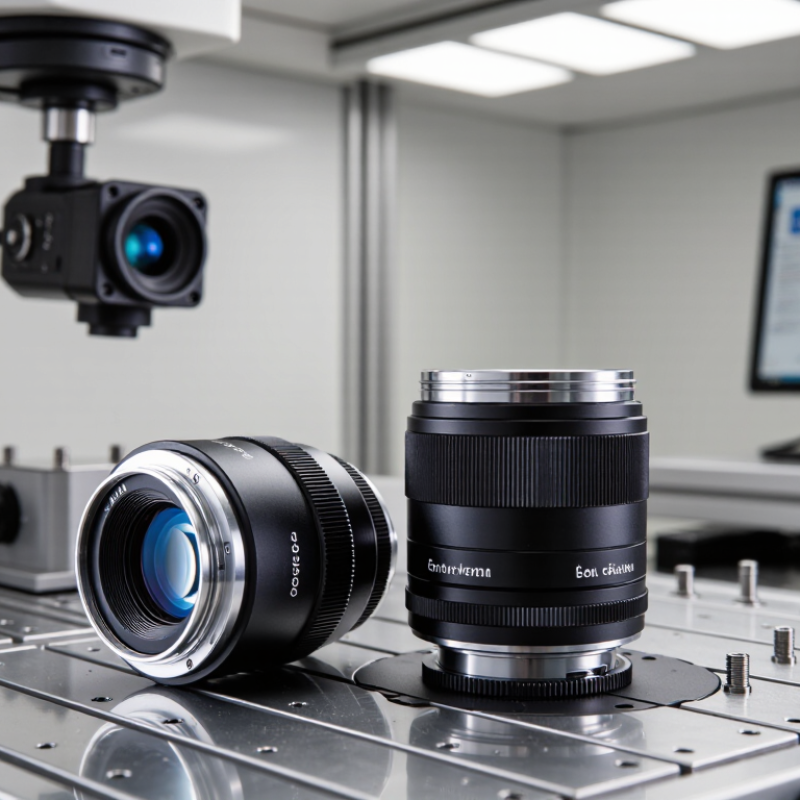
What Bi-Telecentric Lenses Are and Why Global Buyers Use Them
Bi-telecentric lenses keep magnification nearly constant on both sides of the optical system. Their parallel chief rays reduce perspective distortion and make dimensional inspection more repeatable. A 10-millimeter metal part can appear nearly the same size, even when its position shifts slightly along the optical axis. That matters when conveyors vibrate or parts sit at uneven heights. The design supports accurate measurements of holes, edges, gaps, and molded profiles. It is not magic, though. Working distance, sensor size, and lighting still limit performance.
Global buyers use these lenses as machine vision adoption expands. MarketsandMarkets estimates that the machine vision market could grow from about USD 13.0 billion in 2022 to USD 17.2 billion by 2027. A3 reported 31,159 robot units ordered in North America during 2023, showing continued demand for automated inspection. Bi-telecentric optics often fit these systems because stable geometry reduces calibration errors and false rejects. In practice, engineers should test the smallest feature, not only the overall image. A lens may deliver excellent edge accuracy but insufficient depth of field. That uncomfortable detail is easy to overlook. Experienced integrators therefore compare working distance, telecentricity error, distortion, illumination angle, and sensor compatibility before purchase. Geological? No, optical testing remains the safer decision.
China Top Bi-Telecentric Lens Suppliers for Global Buyers — What Bi-Telecentric Lenses Are and Why Global Buyers Use Them
A practical specification and purchasing guide for selecting bi-telecentric imaging lenses for industrial machine vision and precision metrology.
| Evaluation Dimension | What It Means | Typical Bi-Telecentric Lens Characteristics | Why It Matters to Global Buyers | Recommended Verification Method |
|---|---|---|---|---|
| Optical Definition | A bi-telecentric lens is telecentric in both object space and image space. Its chief rays are designed to remain parallel to the optical axis on both sides of the lens. | The lens minimizes changes in image size caused by moderate variation in object distance and maintains stable imaging geometry. | Useful when inspection accuracy is more important than a compact or low-cost optical design. | Request the supplier’s optical layout, telecentricity specification, and measurement conditions. |
| Magnification Stability | Magnification stability describes how consistently a feature is reproduced when its position changes slightly along the optical axis. | Very low magnification variation compared with conventional entocentric lenses, provided the object remains within the specified telecentric working range. | Helps reduce dimensional errors when parts have height tolerances, surface unevenness, or fixture variation. | Test a calibrated target at several object distances and compare measured pixel dimensions. |
| Perspective Error | Perspective error occurs when nearer portions of an object appear larger than farther portions. | Strongly suppressed because object-space chief rays are approximately parallel to the optical axis. | Important for measuring outside diameters, hole locations, edge positions, and component profiles. | Measure a certified dimensional artifact at the center and edges of the field of view. |
| Distortion | Distortion is the geometric displacement of image points from their ideal locations, commonly expressed as a percentage of image height. | Precision bi-telecentric designs commonly target very low distortion; the actual value depends on field size, magnification, and optical architecture. | Low distortion simplifies calibration and improves the reliability of automated dimensional inspection. | Ask for a distortion map or test report based on a grid target rather than relying only on a nominal specification. |
| Telecentricity Error | Telecentricity error indicates how far the chief-ray angle deviates from the ideal parallel condition. | Lower angular error generally produces better measurement consistency, but the specification should identify whether it refers to object space, image space, or both. | Allows buyers to compare optical performance using a defined and measurable parameter. | Confirm the reported unit, measurement wavelength, field position, and acceptable tolerance. |
| Working Distance | Working distance is the distance from the front reference of the lens to the object plane in the intended operating setup. | Common industrial configurations are designed around fixed working distances, often from approximately 65 mm to more than 200 mm, depending on the model. | A suitable working distance must leave room for lighting, grippers, protective windows, and mechanical safety clearance. | Check the manufacturer’s mechanical drawing, reference surface, tolerance, and clearance envelope. |
| Magnification Range | Magnification determines the relationship between object size and sensor image size. | Industrial bi-telecentric lenses are available in various fixed magnifications, commonly including low-magnification options below 0.5× and higher-magnification options above 1×. | The correct magnification ensures that the inspection area fits the sensor while preserving sufficient pixel resolution. | Calculate: magnification = sensor active dimension ÷ required object field dimension. |
| Field of View | Field of view is the observable object area that reaches the camera sensor. | Field size depends on magnification, sensor format, image circle, and usable optical coverage. | Global buyers can prevent edge clipping and avoid selecting a lens that does not cover the complete inspection area. | Compare the lens image circle and sensor format with the required horizontal and vertical field dimensions. |
| Sensor Compatibility | Sensor compatibility indicates whether the lens provides adequate image coverage and resolution for the camera sensor. | Compatibility should be checked against sensor format, diagonal size, pixel pitch, spectral response, and mounting interface. | Prevents vignetting, corner softness, unused sensor area, and unexpected resolution loss. | Confirm image-circle diameter, mount type, flange distance, and compatibility with the selected camera. |
| Resolution and MTF | Modulation Transfer Function describes how well the optical system preserves contrast at different spatial frequencies. | High-quality designs provide adequate contrast across the required field, but performance may decrease toward the image corners or at larger apertures. | High MTF is necessary when the inspection depends on small edges, narrow gaps, or fine surface features. | Request MTF data at relevant wavelengths, apertures, field positions, and spatial frequencies. |
| Depth of Field | Depth of field is the object-space range that appears acceptably sharp under a defined resolution criterion. | Bi-telecentricity stabilizes magnification, but it does not eliminate the normal trade-off between aperture, resolution, illumination, and depth of field. | Buyers should not select a lens solely because it is telecentric when parts vary significantly in height. | Define the acceptable blur or measurement error and request a depth-of-field test under actual lighting. |
| Aperture and Illumination | The aperture controls light transmission, resolution, and depth of field. Telecentric imaging is frequently paired with controlled machine-vision lighting. | Many systems use coaxial, backlight, dome, or telecentric illumination depending on whether the application needs surface, silhouette, or dimensional contrast. | Correct lighting often has as much impact on inspection reliability as the lens itself. | Evaluate the complete lens, camera, lighting, and part combination rather than testing the lens in isolation. |
| Spectral Performance | Spectral performance describes how the lens behaves at the illumination wavelength used by the camera system. | Standard visible-light versions are common; special configurations may be required for near-infrared, ultraviolet, or narrow-band imaging. | Matching coatings and optical correction to the working wavelength can improve contrast and reduce chromatic measurement errors. | Specify wavelength, bandwidth, illumination type, and required transmission before requesting a quotation. |
| Mechanical Interface | The mechanical interface includes the camera mount, housing dimensions, focus or aperture adjustment, and mounting provisions. | Industrial configurations may use common machine-vision mounts, but the exact thread, flange distance, housing diameter, and adjustment method must be confirmed. | Mechanical compatibility reduces integration time and avoids custom adapters or interference with fixtures. | Review a dimensioned CAD drawing and confirm all interfaces with the camera and machine designer. |
| Calibration Requirements | Calibration converts image coordinates into reliable dimensional measurements and compensates for system-level effects. | Bi-telecentric optics reduce geometric sensitivity, but calibration is still required for pixel scale, alignment, lighting variation, and camera installation errors. | Supports repeatable inspection across production lines and replacement cameras. | Use a traceable calibration target and define recalibration frequency and acceptance criteria. |
| Application Fit | Bi-telecentric lenses are intended for applications requiring stable geometry and repeatable measurement. | Typical uses include dimensional metrology, electronic component inspection, semiconductor packaging, connector inspection, pharmaceutical packaging, bottle and cap inspection, and precision part gauging. | They are especially valuable where a small measurement error can cause false rejects or missed defects. | Run a sample-part trial using production tolerances, actual lighting, camera settings, and required cycle time. |
| Supplier Qualification | Supplier qualification evaluates whether a manufacturer can deliver consistent optical and mechanical performance at the required volume. | Important evidence includes inspection reports, optical test methods, lot-to-lot consistency, engineering support, packaging controls, and documented change management. | Helps global buyers reduce quality variation, integration delays, and supply-chain risk without relying only on catalogue specifications. | Request samples, a formal datasheet, quality records, production lead time, warranty terms, and a written acceptance specification. |
| Total Cost of Ownership | Total cost includes the lens, camera compatibility, lighting, adapters, calibration, installation, maintenance, and possible redesign work. | A higher initial optical cost may be justified when it reduces calibration complexity, rework, false rejects, or measurement uncertainty. | Global buyers can compare solutions based on system performance rather than purchase price alone. | Prepare a complete system cost model and compare measurement capability, serviceability, lead time, and replacement availability. |
Note: Numerical ranges and performance descriptions are representative industry guidance, not universal specifications. Final selection should be based on the supplier’s validated datasheet, optical test conditions, sample-part results, and the buyer’s required measurement uncertainty.