Top 10 Industrial Water Pump Manufacturers Worldwide
An Industrial Water Pump keeps water moving through demanding operations, from cooling circuits and treatment plants to mining sites and food production lines. Behind every steady flow are practical choices: required capacity, pressure, fluid quality, operating hours, and installation conditions. A pump that performs well in a clean-water test may struggle with abrasive particles or frequent starts. Details matter.
This guide introduces ten leading industrial water pump manufacturers worldwide and considers what buyers should examine when comparing them. Company history can offer context, but it does not guarantee the right fit. Look closely at pump design, construction materials, efficiency data, maintenance access, technical documentation, and local service support. A stainless-steel casing, for example, may suit some corrosive environments, while other applications need different materials and seals. Actual performance depends on the full system, including pipework and controls.
No list is perfect. Rankings can shift with region, application, and available product data. The manufacturers featured here are starting points for research, not a substitute for engineering review. Before selecting equipment, confirm operating requirements with qualified specialists and compare published specifications against real site conditions. Even a small mismatch in flow or pressure can affect energy use and reliability. The aim is a clearer, more grounded view of the global market—and better questions to ask before making a purchase.
Industrial Water Pumps: Core Functions and Main Applications
Industrial water pumps move water through a system at the required flow and pressure. Their core function is not simply to push water; they must match the demands of the process while handling changes in temperature, solids, and operating hours. Centrifugal pumps are common for steady, high-volume flow. Positive-displacement designs can suit duties needing controlled flow or higher pressure. Pressure matters. Operators often check vibration, seal leakage, motor temperature, and flow readings to spot wear before a breakdown stops production.
Applications vary across industrial sites. In factories, pumps supply process water, wash equipment, and circulate cooling water through heat exchangers. Cooling systems depend on reliable circulation; a blocked strainer can reduce flow and raise temperatures. Wastewater facilities use pumps to transfer water containing suspended material, so impeller clearance and solids handling matter. Mines and construction sites may need dewatering pumps to remove water from pits or work areas. Food-processing plants use water for cleaning and production, where material compatibility and cleanability deserve close attention. Small details count. Actual operating conditions rarely stay perfectly steady, and a tidy specification can miss that. Reviewing flow, pressure, fluid quality, and maintenance access together gives a more realistic basis for selecting and running a pump.
How Leading Manufacturers Are Evaluated and Compared
Comparing industrial water pump manufacturers starts with the operating point, not the catalogue headline. Check each pump’s published curve against the required flow and total head. A unit rated for high flow may perform poorly when the system needs greater pressure. Confirm the liquid’s temperature, viscosity, and solids content, too. These details affect materials, seals, and expected wear.
Look for documented test procedures, traceable performance data, and clear information about materials and efficiency. Ask how quoted performance was measured and whether it reflects your actual duty conditions. Service access matters. So do spare-part availability and realistic delivery times. A neat scorecard helps, but it can hide trade-offs; weighting every factor equally is rarely right.
Tips: Compare offers using the same flow, head, and liquid conditions. Request the pump curve and a written explanation of any assumptions. Check the likely operating point, not just peak efficiency. If possible, review maintenance records from a similar installation. A site visit can reveal useful details, though one visit cannot prove long-term reliability. No comparison is perfect. Revisit your criteria when the operating data is incomplete.
Profiles of Ten Major Industrial Water Pump Manufacturers
Industrial water pump manufacturers differ less by catalog size than by the problems they solve. Ten useful profiles include makers focused on engineered process pumps, submersible wastewater units, vertical turbine pumps, split-case designs, and high-pressure multistage systems. Others specialize in magnetic-drive equipment, corrosion-resistant materials, solids-handling impellers, packaged pump skids, or field service and retrofits. These are distinct capabilities, not a brand ranking. Buyers should compare flow, head, fluid chemistry, solids content, seal design, and maintenance access. A pump that suits a clean-water loop may struggle with abrasive sludge.
Energy use deserves close scrutiny. The U.S. Department of Energy’s Improving Pumping System Performance sourcebook estimates pumping systems use nearly 20% of the world’s electrical energy demand; some industrial plants spend 25–50% of their energy on pumping. The sourcebook dates to 2006, so treat those figures as broad context, not a current site estimate. Ask manufacturers for duty-point curves, efficiency data, materials specifications, and service intervals. Check performance at actual operating conditions, not only at a catalog’s best point. Small details matter. A tight equipment room can make routine seal work awkward. And a profile can look impressive on paper while leaving local parts availability unclear. That deserves a second look.
Industrial Water Pumps: Illustrative Shaft Power by Flow Rate
This illustrative calculation shows how required pump shaft power increases with flow rate when water is pumped at a constant 50 m head and pump efficiency of 75%. It uses the hydraulic power equation and assumes water density of 1,000 kg/m³; values are not manufacturer specifications.
Key Pump Technologies, Product Ranges, and Specialties
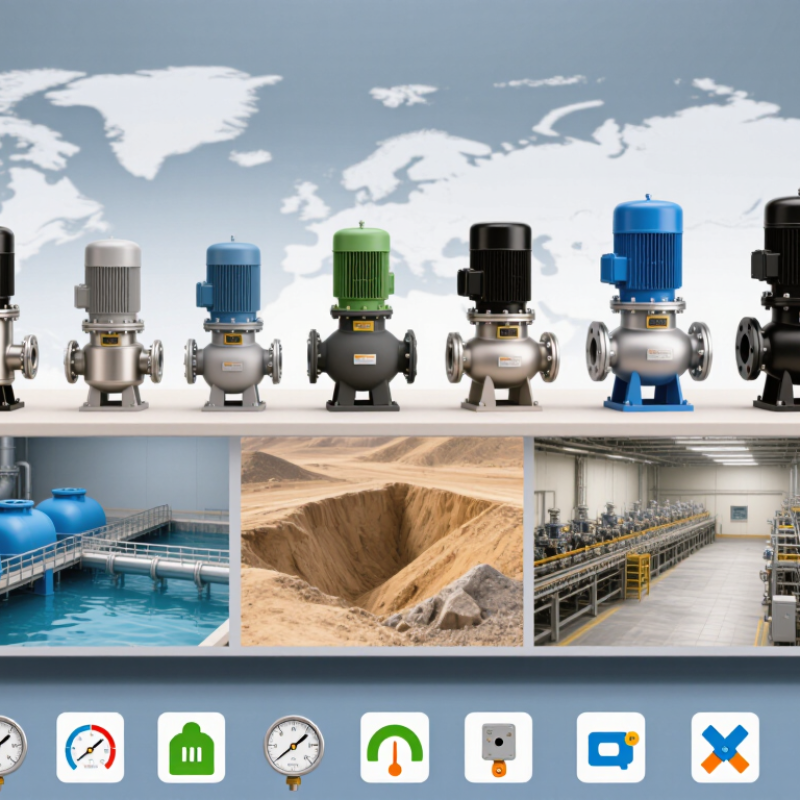
Industrial water pump manufacturers typically build several technologies for different flow and pressure demands. Centrifugal pumps handle steady water transfer in treatment plants, cooling loops, and irrigation networks. Multistage models add pressure through stacked impellers, making them useful for boilers and tall buildings. Submersible pumps operate below the waterline, including in wells, sumps, and drainage pits. Positive-displacement designs move a measured volume per cycle and suit dosing or viscous fluids. Details matter.
Product ranges may include end-suction, split-case, vertical turbine, and axial-flow pumps. Each serves a different duty point, not simply a different installation style. Split-case units can support high flow, while vertical turbine pumps fit deep water sources with limited surface space. Axial-flow models move large volumes against relatively low head. Manufacturers may also offer variable-speed drives, mechanical seal options, and corrosion-resistant materials. These choices affect efficiency, maintenance intervals, and service life.
A useful technical comparison looks beyond maximum flow claims. Pump curves show how flow and head change together, while efficiency and power data help estimate operating costs. For abrasive water, solids passage and impeller clearance deserve close attention. For hot or chemically treated water, seal materials and casing alloys need careful review. A specification can still miss real site conditions, especially fluctuating water levels or unexpected debris. Reviewing operating data with an experienced pump engineer helps narrow the range, though field conditions can remain imperfect.
Global Service Networks and Industrial Buyer Considerations
A global service network matters when a pump fails far from the factory. Buyers should check local technician coverage, spare-part stock, and response times—not just the number of service offices. Ask who handles a night-time breakdown, and whether critical seals and bearings are available nearby. Details matter.
The International Energy Agency’s 2016 World Energy Outlook water-energy analysis estimates that water services use about 4% of global electricity. Pumping efficiency therefore affects operating costs as well as reliability. The U.S. Department of Energy’s Improving Pumping System Performance guide recommends assessing the whole system, including controls, piping, and operating conditions. A replacement pump alone may not fix a poorly matched installation.
Compare manufacturers on commissioning support, maintenance training, and access to compatible parts across regions. Request written service-level targets and references from sites with similar fluids, temperatures, and duty cycles. A fast response on paper is not the same as a stocked local workshop. Service maps can also become outdated; buyers should verify coverage directly before signing. Cite the data source and report year in procurement documents, so later teams can check the assumptions.