
10 Electric Tricycle Buying Tips for Global Buyers

Buying an Electric Tricycle is not simply a matter of choosing a motor and three wheels. It is a practical decision involving payload, battery safety, terrain, service access, and daily comfort. For global buyers, one attractive model may perform poorly on steep roads, rough paths, or humid coastal streets.

The International Energy Agency’s Global EV Outlook 2024 reports that electric two- and three-wheelers remain the largest electrified road-transport segment worldwide. Global sales exceeded 20 million units in 2023, with strong demand across China, India, Southeast Asia, and parts of Africa. The report also highlights battery cost, charging access, and local manufacturing as important market influences. These figures show opportunity, but they do not guarantee a suitable purchase.

Micromobility analyst Horace Dediu defines the sector as “the ability to move people and goods using lightweight vehicles.” That sentence matters here. An Electric Tricycle must move real people, groceries, tools, or parcels, not just look efficient in a product photograph. Buyers should inspect frame welds, braking distance, tire width, battery certification, controller protection, and replacement-part availability. Small details become expensive later.

This guide presents ten buying tips for international customers. It examines performance claims, supplier reliability, warranty language, and after-sales support. Some recommendations may seem obvious. They are still often missed. Even experienced buyers can overestimate range or underestimate cargo weight. A careful checklist cannot remove every risk, but it can expose weak assumptions before payment.
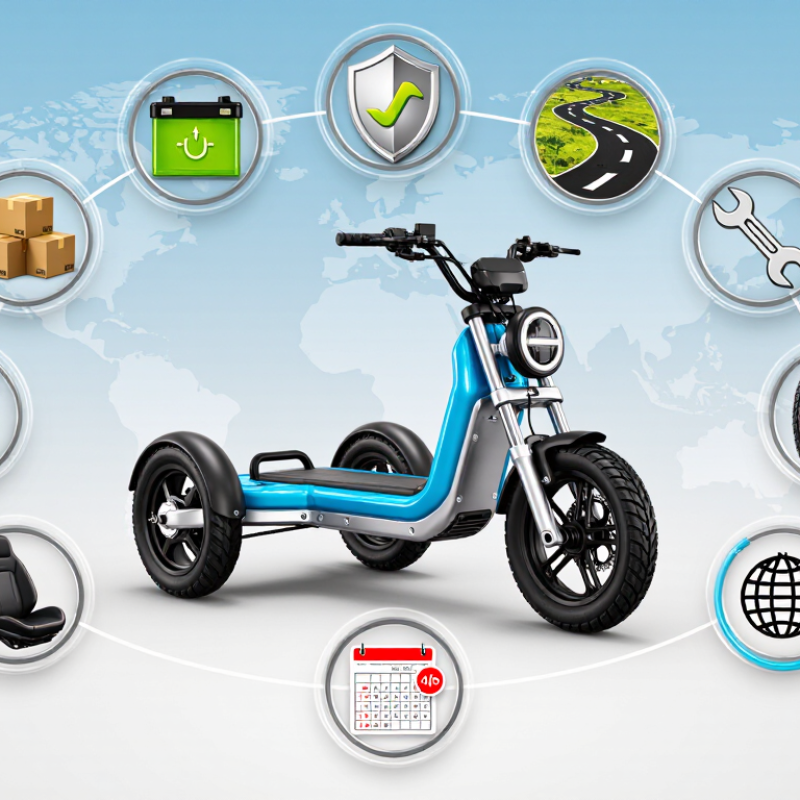
10 Electric Tricycle Buying Tips for Global Buyers

Define Your Use Case, Riders, and Daily Transport Needs

Before comparing electric tricycles, define the daily job clearly. Will it carry one adult, two children, groceries, tools, or small parcels? A passenger model may feel stable but offer limited cargo space. A cargo model may be practical but harder to park.

Write down the rider’s height, weight, strength, and riding confidence. An older rider may need a low step-through frame, wide tires, simple controls, and strong parking brakes. A taller rider needs adjustable handlebars and enough legroom. Two riders? Check the seating area, footrests, and approved load capacity. Do not estimate by appearance.

Think about the route in detail. Measure narrow gates, apartment elevators, storage doors, and turning areas. Note hills, loose gravel, rain, heat, and daily distance. A short urban trip may need easy handling more than maximum speed. A long route needs comfortable seating, predictable battery range, and accessible charging. Range claims can change with rider weight, hills, temperature, and tire pressure.

Use a normal shopping load during a test ride. Feel the steering when turning slowly. Test braking on a quiet, dry surface. Listen for rattles. Small details matter. I would also repeat the test after loading the rear basket, because balance can change noticeably. This step is easy to skip, and regrettably, it often exposes the wrong choice later. Share the route and rider details with a qualified seller, then request specifications in writing.

Compare Motor Power, Battery Capacity, and Practical Range

10 Electric Tricycle Buying Tips for Global Buyers

Motor power matters, but wattage alone can mislead. Compare continuous power, peak power, controller limits, and hill performance. A 750-watt motor may outperform a 1,000-watt unit with better torque control. Ask for tested climbing results, not only catalogue figures. Load changes everything. Include the rider, cargo, accessories, and road gradient when comparing models. The IEA’s Global EV Outlook 2024 identifies electric two- and three-wheelers as the largest electric road-vehicle segment by sales, making transparent specifications increasingly important for international buyers.

Measure watt-hours. A 48-volt, 20Ah battery stores about 960Wh nominally. Usable energy is lower because of reserve limits, temperature, battery age, and conversion losses. If a vehicle consumes 20Wh per kilometre, its theoretical range approaches 48 kilometres. Real operation may deliver 30 to 40 kilometres with cargo, hills, wind, or frequent stops. Range claims can mislead. Request test speed, payload, tyre pressure, road surface, and ambient temperature. BloombergNEF’s Battery Price Survey 2024 reported an average lithium-ion pack price of 115 US dollars per kWh, yet retail pricing also covers casing, controls, certification, logistics, and warranty support.

Check charging time, removable-battery weight, replacement availability, and local electrical compatibility. A battery that seems large may be inconvenient upstairs. A powerful motor may drain it quickly. No calculation is perfect. Buyers should compare measured energy consumption, not just advertised kilometres. Service documentation and battery warranty deserve the same attention as motor output.

Check Frame Strength, Load Capacity, Comfort, and Stability

10 Electric Tricycle Buying Tips for Global Buyers

A strong frame is the starting point. Inspect welds, joints, and tubing for uneven gaps or visible cracks. Thick metal does not always mean better quality. Ask for the frame material, corrosion treatment, and maximum permitted load. Check whether that load includes the rider, battery, cargo, and accessories. The rear axle should feel firm, without side-to-side movement. A weak axle can affect control under heavy cargo.

Measure the cargo area before buying. Boxes should sit low and stay inside the wheelbase. A high load may make the tricycle feel unstable on turns. Wide tires can improve balance on rough roads, but they may increase rolling resistance. Test the brakes with a full load, not an empty vehicle. They should stop smoothly, without pulling sharply to one side. This detail is often ignored.

Comfort also affects safe riding. Look for an adjustable seat, reachable handlebars, and enough legroom. A low step-through frame helps riders mount more easily. Suspension can reduce shocks on uneven streets, but soft suspension may increase body movement. During a test ride, check stability while starting, stopping, and turning slowly. Listen for rattles. They may reveal loose parts. In practical inspections, buyers often focus on battery range and overlook frame balance. I have made that mistake myself. Specifications are useful, but real cargo placement can change the riding feel. Ask for independent test data when available, and compare measurements with your daily route, climate, and road surface.

10 Electric Tricycle Buying Tips for Global Buyers - Check Frame Strength, Load Capacity, Comfort, and Stability

No. Buying Factor What to Check Practical Benchmark Why It Matters Buyer Action
1 Frame Strength Inspect the frame material, weld quality, joint design, corrosion protection, and areas supporting the rear axle or cargo box. Look for reinforced joints, continuous and even welds, corrosion-resistant finishing, and a clearly stated maximum gross vehicle weight. A strong frame improves durability, handling, and resistance to fatigue under repeated loads. Request frame drawings, weld photographs, and the rated gross vehicle weight before ordering.
2 Load Capacity Confirm whether the published rating includes the rider, passengers, cargo, battery, and accessories. Choose a model with at least a 15–20% capacity margin above the expected everyday load; never exceed the manufacturer’s stated limit. Overloading can increase braking distance, reduce stability, accelerate wear, and overheat the motor or controller. Calculate the heaviest normal payload and compare it with the complete-vehicle load rating.
3 Stability and Wheelbase Evaluate track width, wheelbase, center of gravity, axle design, steering response, and resistance to tipping during turns. A wider rear track and a low, well-distributed cargo position generally provide better stability; test slow and moderate-speed cornering safely. Three-wheel vehicles can become unstable if loads are placed high or if turns are taken too quickly. Test the tricycle with representative cargo and verify that the load is centered and secured.
4 Motor and Hill Performance Check continuous motor power, peak power, torque, controller rating, and the manufacturer’s specified gradeability. Compare performance using the intended total load and slope; continuous power is more useful than peak power for sustained hills. Peak ratings may last only briefly, while continuous output affects real-world climbing and thermal performance. Ask for a loaded hill test or performance data at the maximum intended payload.
5 Battery Capacity and Safety Verify battery voltage, ampere-hours, usable energy, cell protection, charging temperature limits, and replaceability. Approximate energy is calculated as volts × ampere-hours; compare usable range under load rather than an unloaded laboratory claim. Battery capacity determines operating range, while protection systems help reduce overcharge, over-discharge, and thermal risks. Request battery test documentation, charger specifications, and a clear replacement plan.
6 Braking System Check front and rear brakes, parking brake, brake cut-off function, cable or hydraulic condition, and accessibility of replacement parts. Brakes should stop the fully loaded vehicle in a controlled manner on the intended surface and remain effective after repeated use. Additional mass increases stopping distance and places greater heat and wear demands on the braking system. Perform loaded braking tests on dry and slightly sloped surfaces in a controlled, legal area.
7 Rider Comfort and Ergonomics Inspect seat width, back support, handlebar position, step-through height, pedal position, suspension, and vibration control. The rider should sit upright with relaxed shoulders, a slight bend at the elbows, secure foot placement, and easy access to controls. Good ergonomics reduce fatigue and improve steering and braking control during longer trips. Have the primary rider complete a 20–30 minute test ride before purchase.
8 Tires, Wheels, and Ground Clearance Confirm tire size, load index, tread pattern, tube or tubeless construction, rim strength, spare availability, and clearance. Use tires with a load rating above the actual wheel load and select tread appropriate for paved roads, gravel, or mixed surfaces. Correct tires improve grip, comfort, puncture resistance, and control over uneven surfaces. Check tire markings and ensure replacement tires and tubes are available in the destination market.
9 Lighting and Weather Protection Review headlamps, tail lamps, indicators, reflectors, horn, fenders, waterproof connectors, and enclosure protection. Lighting should be visible from the required distances in the destination market; electrical components should have documented water-resistance protection. Visibility improves road safety, while weather protection helps prevent electrical faults and corrosion. Check local lighting, reflector, electrical, and road-use requirements before importation.
10 Serviceability and Compliance Assess spare parts, service manuals, warranty terms, diagnostic support, charging compatibility, and required vehicle certification. Confirm compatibility with the local electrical supply and verify applicable rules for speed, power, dimensions, lighting, brakes, and road classification. Local compliance and accessible parts reduce downtime, import risk, and long-term ownership costs. Obtain a parts list, warranty procedure, user manual, compliance documents, and after-sales contact details in writing.
Note: Specifications, legal classifications, safety requirements, and allowable dimensions vary by country and intended use. Always verify the applicable local regulations and conduct a fully loaded safety test before regular operation.

Verify Safety Features, Legal Compliance, Warranty, and Service

10 Electric Tricycle Buying Tips for Global Buyers

Verify safety features before comparing price. During a practical inspection, test both brake levers, parking brakes, lights, reflectors, and reverse alarms. Confirm that the motor stops when braking. Check frame welds, tire load ratings, steering clearance, and battery mounting on uneven ground. A small omission matters. The U.S. Consumer Product Safety Commission reported 233 micromobility deaths from 2017 to 2022, with approximately 19,700 injuries in 2022. These figures cover several vehicle types, not electric tricycles alone, but they justify careful testing.

Legal compliance differs by country, city, and vehicle classification. Ask for documented ratings, technical files, charger certifications, and battery transport information. Do not rely on a seller’s phrase, “road legal.” Verify speed limits, maximum power, lighting rules, helmet requirements, registration, and insurance with the destination authority. The EU Battery Regulation 2023/1542 also introduces requirements for battery information, traceability, and sustainability. Local rules can change. Recheck them before shipment.

Warranty language needs measurable details. Require coverage periods for the frame, motor, controller, charger, and battery separately. Ask whether battery coverage depends on capacity retention or charging cycles. Confirm spare-parts availability, diagnostic support, repair locations, and response times. A long warranty can still be weak if labor and shipping are excluded. I have seen buyers focus on months of coverage while overlooking service delays. That deserves honest reflection. Keep inspection photos, serial numbers, invoices, and promised specifications in one file.

Calculate Shipping, Import Costs, Maintenance, and Total Value

Shipping can quietly reshape an electric tricycle’s price. Request a delivered quote, not only a factory price. Include ocean or air freight, insurance, port handling, inland delivery, and customs brokerage.

The World Bank’s 2023 Logistics Performance Index shows that customs efficiency and transport infrastructure strongly affect delivery reliability. Delays can also create storage charges.

Ask for carton dimensions and gross weight before ordering.

Import duty depends on the destination, product classification, battery type, and declared value. Do not guess the tariff. Verify the classification with a licensed customs professional.

Calculate duty and tax separately from freight. A simple worksheet helps:

purchase price, shipping, insurance, duty, tax, assembly, and local delivery.

Keep a contingency reserve of 10% to 15%. I once underestimated port charges. It changed the decision.

Maintenance determines total value after delivery. Check battery replacement pricing, tire availability, brake components, controller access, and technician labor rates.

The International Energy Agency reported that average battery pack prices fell 14% in 2023, but replacement prices still vary widely by chemistry and supplier.

Ask for a written battery warranty and charging specifications. Count electricity too. Annual energy cost equals battery capacity, charging losses, local electricity rates, and expected usage.

The U.S. Department of Energy recommends tracking operating costs over time, not relying on purchase price alone. Cheap upfront can become expensive later. Recheck every assumption.

Article Source:

Go to Top